
Mice only need a tiny gap to get inside, so stopping them means knowing where homes tend to be weak and tackling the entry points carefully.
Mice have flexible bodies and can pass through a hole not much wider than a pencil. If a mouse can get its head through, the rest of it can usually follow. Because of this, a house that looks tightly built can still have several ways in. Mice also climb well, run along pipes and cables, and jump surprisingly high. An opening does not need to be at ground level for a mouse to use it, so it pays to think about the whole building and not just the base of the walls.
Most routes in are unplanned gaps left during building work or created by wear over time. Older houses have more settling and cracking, while newer estates often have small gaps where services pass through the wall. Check the outside of the property first, working slowly around the walls with a torch. Look for any gap where something passes through or meets another surface.
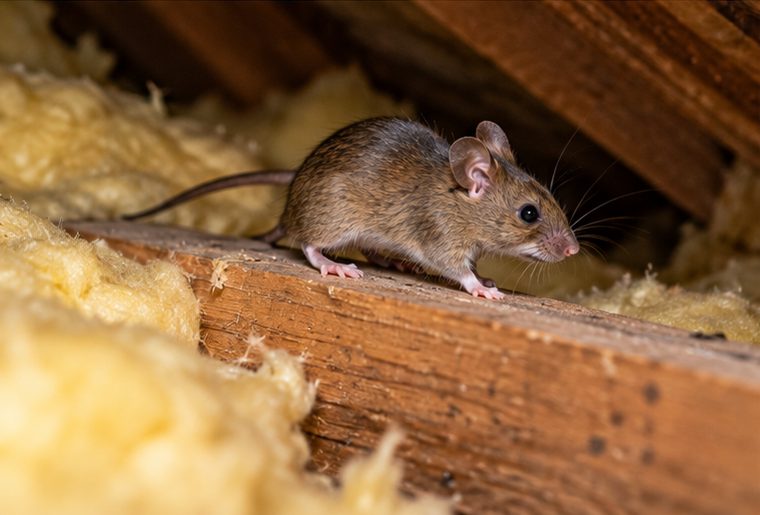
Mice come in for food, warmth and shelter. Gardens with long grass, compost heaps, stored firewood and piles of rubbish give them cover close to the walls. Seed spilled on the ground and outdoor pet food also attract them. In Essex, homes beside farmland, field edges, allotments and woodland tend to see mice moving in as the nights get cooler. Coastal and estuary areas are not immune either, as mice can live in sheds, outbuildings and beach huts before moving into houses.
Tidy the outside first. Cut back vegetation touching the walls, move wood piles and compost away from the house and keep bins closed. Indoors, store food in tight containers and keep stored boxes off the floor so any activity is easier to spot. Small gaps around pipes can be closed with materials that mice cannot chew through easily. Fit brush strips to door bottoms and make sure air bricks have intact covers. Work carefully and never block an opening while you think a mouse may be inside.
Do not fill holes with foam or soft filler alone, as mice can gnaw straight through it. Avoid stuffing a gap if there are signs of live activity behind it, because trapped mice often chew a fresh way out somewhere else, sometimes into a room. Also avoid laying poison as a first response. It does nothing about the gaps, and it risks harming pets, children and wildlife, as well as leaving a dead mouse in a place you cannot reach.
If you keep seeing signs after tidying up, or you cannot find where they are getting in, ask us to help. We look at the whole property, including roof spaces, voids and outbuildings, find the routes mice are using and deal with the activity safely. We can then advise which gaps to close and in what order. Proofing is most effective once the mice have been dealt with, so the work is done in the right sequence.
Proofing is not a one-off job. Walk around the house a couple of times a year, ideally before autumn, and check that seals, vents and door brushes are still in good condition. Repair cracks as they appear, and keep the garden tidy near the walls. If you have had mice before, check for new signs regularly, such as droppings in cupboards or gnawing on packaging. Catching a problem when it is small is far easier than dealing with a settled colony.
If you would rather not deal with it yourself, call us on 01245 327 274 or send an enquiry below. You can also read more about our mice control service.
 BPCA Member
 CHAS Accredited
 Buy With Confidence
 Three Best Rated 2026
We cover towns and villages across Essex. Choose your area to see how mouse control works locally.

Mice are small, quiet and mostly active at night, so the evidence they leave behind is often the first thing you notice, long before you see one.
Read the guide →
Most household pests leave clues behind, and learning to read droppings, damage, noises and timing will help you decide what you are dealing with and what to do next.
Read the guide →
Rats are secretive and mostly active after dark, so the first clues are usually small marks and sounds rather than a sighting of the animal itself.
Read the guide →A mouse can squeeze through a gap about the width of a pencil, because its skull is small and its body is flexible. That is why even a tidy house can have entry points. Checking around pipes, vents and door bottoms is a good starting place.
Yes. Mice are good climbers and can scale rough brickwork, pipes, cables and trellis to reach gaps higher up. They can also reach the loft through eaves and roof edges, so entry points need checking above ground level as well as near the base of the walls.
Sometimes it is, if you are sure no mice are inside. If there is still activity, sealing the gaps can trap them indoors and push them to gnaw new routes. It is safer to have the activity dealt with first, then proof the property afterwards.
They can. New estates often sit beside fields or building land, and small gaps around service pipes and cables are common. Mice also arrive during construction and in stored materials. Newer houses may have fewer cracks, but they are not mouse proof by default.
Tell us what you have found and roughly where it is. We will come back to you — or call 01245 327 274 if it is urgent.
