
A single wasp is usually just passing through, but a steady stream flying to and from one spot is the clearest sign that a nest is close by.
A lone wasp drifting around the garden in summer is normal. They are looking for food and water, and most will move on. What matters is repetition. If you see wasps flying in a straight line to the same place, again and again, through the day, they are almost certainly travelling to a nest. Watch from a good distance, and for only a few minutes. You do not need to get close to learn what you need to know.
Wasps like sheltered spots that are dry and undisturbed. In Essex homes that usually means lofts and roof spaces, under eaves, inside wall cavities, in sheds and garages, and in old air bricks. Some build in the ground, using a disused burrow, or in thick hedges and trees. Older houses with small gaps in the fascias and soffits give easy access, but modern estates have nests too.
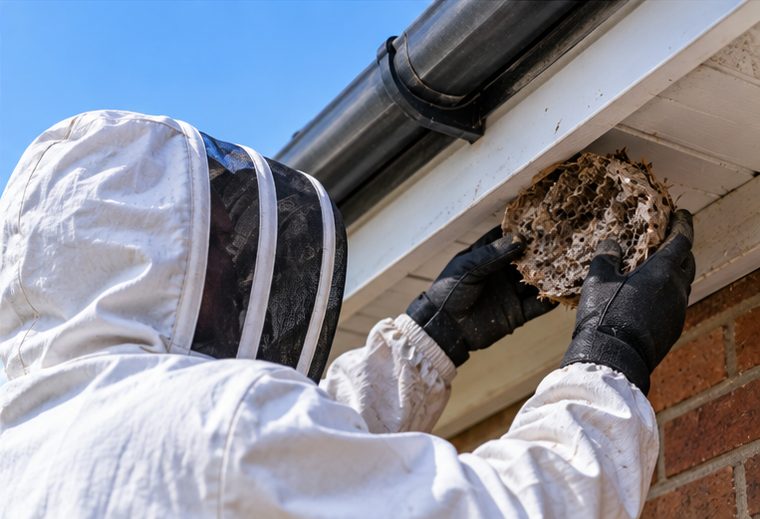
The strongest sign is a flight path, with wasps entering and leaving a single gap. Inside a loft or wall you may hear a steady, dry scratching or rustling, which is the sound of workers chewing wood to make paper. You might also notice a brown or grey stain spreading on a ceiling. A visible nest is rounded and layered, a bit like grey paper, and it may be anywhere from golf ball size to much larger as summer goes on.
Not every stinging insect is a wasp. Bees are rounder and furrier, and honeybees are an important species that should not be harmed. Bumblebees often nest in the ground or in old holes and are usually gentle. Wasps are smooth and slim with bold black and yellow bands, and hornets are larger with a more orange tone. If you are not sure what you have, send us a photograph taken from a safe distance, because the right response is different for each.
Keep children and pets away from the area and keep windows near it closed. Avoid walking close to the entrance, and do not stand and watch for long. Cover bins and clear sweet food and drinks outside so wasps are less drawn to your garden. Make a note of where the flight path is, and when it is busiest, so you can tell us. That is all you need to do. The rest is safest left to a trained professional.
Do not poke, spray, flood, block or try to burn a nest. Disturbed wasps defend the colony aggressively, and a nest in a wall or loft can send them into the living space if the entrance is blocked. Do not use a ladder near a nest. Anyone with a known allergy to stings should stay indoors and call for help straight away. If someone is stung and feels unwell, short of breath or has swelling of the face or throat, call emergency services.
Call as soon as you are fairly sure there is a nest, especially if it is near a door, a window, a play area or a place where people walk. We will confirm what it is, tell you what we found and treat it safely. Early calls are easier, because a young nest is smaller and the problem is more contained. If you are in any doubt, a quick message with a photograph is a good place to start.
If you would rather not deal with it yourself, call us on 01245 327 274 or send an enquiry below. You can also read more about our wasp nest removal service.
 BPCA Member
 CHAS Accredited
 Buy With Confidence
 Three Best Rated 2026
We cover towns and villages across Essex. Choose your area to see how wasp nest removal works locally.
It is tempting to deal with a wasp nest yourself, but stings, falls and a more aggressive colony make it one of the jobs most worth leaving to a professional.
Read the guide →
Most household pests leave clues behind, and learning to read droppings, damage, noises and timing will help you decide what you are dealing with and what to do next.
Read the guide →
Rats are secretive and mostly active after dark, so the first clues are usually small marks and sounds rather than a sighting of the animal itself.
Read the guide →Often yes. Wasps flying repeatedly to and from the same gap in a roof, wall or bank is a reliable sign, and you may hear scratching or humming from inside. A damp-looking brown stain on a ceiling can also appear. If you see these signs, please keep your distance and call us.
No. A colony dies off at the end of the season and the nest is not used again. New queens leave to find their own sites in spring. However, a spot that suited wasps once may attract a new queen later, so blocking gaps after treatment is sensible.
Eventually the colony dies in late autumn, but that can be months away, and during that time the nest keeps growing. Waiting means more wasps, more risk and sometimes damage to insulation and ceilings. If the nest is close to where people go, it is better dealt with promptly.
No. Many wasps and bees are simply foraging and do a lot of good by eating pests or pollinating plants. The concern is a nest close to people. Honeybees in particular are valuable, and a beekeeper may be a more suitable contact if that is what you have.
Tell us what you have found and roughly where it is. We will come back to you — or call 01245 327 274 if it is urgent.
