
A line of ants across the worktop usually means a scout found food and told the nest, and a few simple habits can break that chain.
Ants live in organised colonies, and a few workers go out to search for food. When one finds something, it lays a scent trail so the others can follow. That is why you often see a neat line from a gap in the wall or door frame, over the worktop, to a crumb or sticky spill. The ants in view are only a small part of the colony. Most of the nest, including the queen, sits elsewhere, often outside under paving or in a wall cavity, which is why wiping the visible ants away rarely ends the problem for long.
Kitchens offer warmth, water and food in one place. Sugary spills, pet food, open jam jars, fruit bowls and unwashed plates all draw ants in, and so does a damp corner under a sink. Warm, dry spells in summer push them indoors looking for moisture. Many Essex homes sit beside gardens, paved patios, field edges and allotments, all places where garden ants nest in numbers. New-build estates with settling gaps and older houses with worn mortar both give them easy ways in.
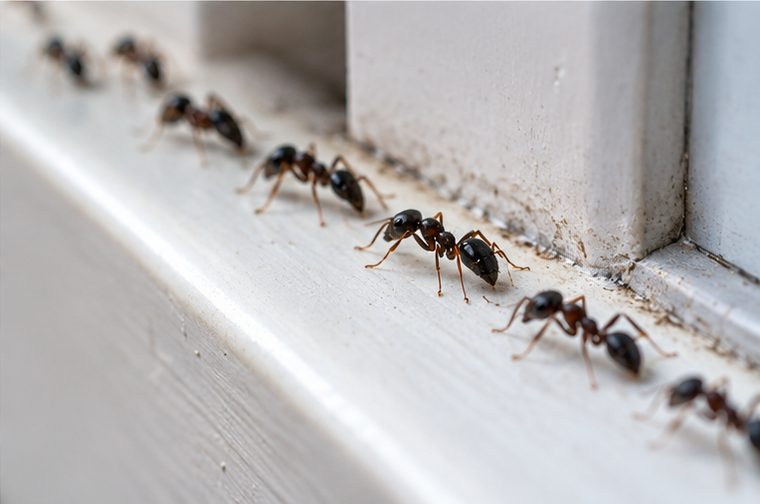
The common black garden ant is the one most people meet. Workers are small and dark and usually come in from outside nests. Occasionally, other types appear, including ants that nest inside the building and stay active all year, which is a different problem altogether. A useful clue is timing. If ants appear in winter, or keep coming in at the same place however clean the room is, a nest may be in the structure itself. A clear photo, or a sample on sticky tape, helps us identify them.
Clean up properly. Wipe the trail with warm soapy water, which removes the scent that guides the others, then deal with whatever drew them in. Store sugar, cereal and pet food in sealed containers, wash dishes promptly, empty the bin often and wipe sticky jars and bottles. Watch where the ants enter and, once you know, seal visible gaps around pipes, windows and door frames with sealant. Fix any dripping tap or damp spot that gives them water.
Avoid spraying large amounts of household insecticide around the kitchen. It can scatter workers, contaminate surfaces where food is prepared, and does not reach the nest. Poured liquids and powders near children and pets add risk without solving the cause. Do not dig into walls or lift paving to hunt for a nest. You may stir it up and send the ants deeper into the structure or into other rooms, which makes the later treatment harder.
Call if ants keep returning after a thorough clean, if you see them in large numbers, or if you suspect a nest inside the building. We find where they enter and where the colony is, and treat so that the nest is dealt with rather than just the visible workers on the worktop. Indoor nests are most likely in warm places such as behind kitchen units, under floors and in cavity walls, and these are hard to reach safely without the right tools and knowledge.
Tidy outside too. Keep bins closed, clear fallen fruit and sweep up crumbs on patios. Trim plants that touch the walls, and repair cracked mortar and gaps near thresholds where scouts find their way in. Inside, make a habit of wiping surfaces at night and storing food away. Consistent small routines remove the reward that brings scouts back, and without a reward the trails soon die away on their own.
If you would rather not deal with it yourself, call us on 01245 327 274 or send an enquiry below. You can also read more about our ant control service.
 BPCA Member
 CHAS Accredited
 Buy With Confidence
 Three Best Rated 2026
We cover towns and villages across Essex. Choose your area to see how ant control works locally.

Flying ants are the winged males and young queens of an ant colony, and their sudden summer swarms are usually short lived and harmless.
Read the guide →
Most household pests leave clues behind, and learning to read droppings, damage, noises and timing will help you decide what you are dealing with and what to do next.
Read the guide →
Rats are secretive and mostly active after dark, so the first clues are usually small marks and sounds rather than a sighting of the animal itself.
Read the guide →Warm, dry weather encourages colonies to grow and sends workers looking for water and sweet food. Kitchens offer both, so trails can appear almost overnight. The nest is usually outside, which explains why they seem to arrive from nowhere on a hot day.
Common garden ants do not bite in any way that matters and are not a serious health threat. They can, however, walk over food and surfaces, which is unpleasant and not hygienic. In a food business that is a concern worth taking seriously.
It breaks the scent trail for a while, which can stop the line, but it does not remove the nest. If food and water stay available and the entry point stays open, new scouts will find the way in again within days.
Most species found in kitchens do not damage the structure. They simply use gaps that are already there. A few kinds do tunnel into soft or damp materials, so repeated indoor activity, especially in winter, is worth having looked at by a professional.
Tell us what you have found and roughly where it is. We will come back to you — or call 01245 327 274 if it is urgent.
