
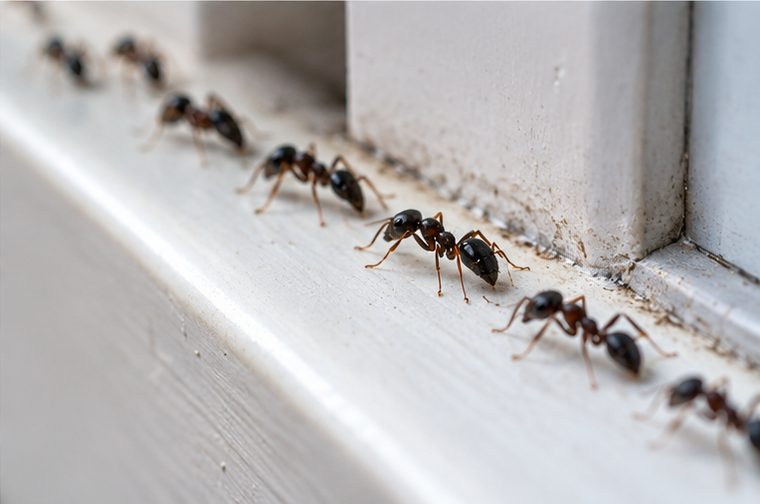
Harlow is built in neighbourhoods divided by green wedges, and that suits ants very well. Grass verges, flower beds and paved paths all sit close to front doors, so a black ant colony outside can reach a kitchen in a matter of days. If you have a line of ants crossing a worktop or a window sill, we can find where they come from and treat the nest.
We work for owners, tenants and landlords. A tenant usually wants the trail gone quickly, and a landlord wants to know what caused it and whether neighbours are affected. We explain what we find, say what is needed and agree the plan with you before we start any treatment.
 BPCA Member
 CHAS Accredited
 Buy With Confidence
 Three Best Rated 2026
Many Harlow homes are flats or terraced houses sharing walls, paths and sometimes a communal garden. That means a nest under a shared path can send ants into several homes at once. Treating only one kitchen may calm things for a week, then the trail returns. It helps to speak to neighbours and to tell us where else ants have been seen.
Inside, ants look for crumbs, sweet drinks, pet food and anything greasy or sticky. Bin cupboards, bread bins and the gap behind the cooker are favourite stops. We check these, follow the trail to the entry point, often a small gap by a pipe, a cracked seal or a threshold, and tell you exactly where it is so it can be sealed properly.

We start by asking where and when you see the ants, then walk the trail from the kitchen outwards. Outside we check paving, wall bases, drain covers and lawn edges for the nest. Once we know what we are dealing with, we apply a targeted treatment where workers will pick it up and take it back, rather than treating every surface in the room.
Safety around children and pets comes first in every Harlow home, so we explain where treatment has gone and how long to leave it alone. Ant colonies can be large, and a nest in a green wedge or a shared bed may be bigger than it looks. If activity continues after a few days, we come back to check on it and adjust the approach we are taking.
Store sugar, cereal and pet food in sealed tubs, empty bins often and keep sticky spills off the floor. Sealing the gaps we point out makes a real difference. If you live in Harlow (CM17 to CM20) and have ants in a shared block, tell your landlord or managing agent as well, so that outside areas get looked at. We also cover Epping and Loughton, and nearby villages.
We cover towns and villages across Essex. Choose your area to see how ant control works locally.
A line of ants across the worktop usually means a scout found food and told the nest, and a few simple habits can break that chain.
Read the guide →
Flying ants are the winged males and young queens of an ant colony, and their sudden summer swarms are usually short lived and harmless.
Read the guide →
Most household pests leave clues behind, and learning to read droppings, damage, noises and timing will help you decide what you are dealing with and what to do next.
Read the guide →That depends on your tenancy agreement and where the nest is. Ants coming from communal areas are often the landlord's or agent's responsibility. It is worth telling them in writing. We can inspect, explain what is causing the problem and give a straightforward account you can pass to the person responsible.
Ants often use window frames and external walls as a route in, especially if the nest is in a flower bed or under paving just outside. They may be heading for a sweet food source elsewhere in the house. We follow the trail to see where it really leads before deciding on treatment.
We use targeted treatments and place them carefully, away from places pets and children can reach where we can. We tell you exactly where they have gone and what to avoid touching or cleaning for a while. If you have a particular worry, mention it when you book and we will plan around it.
Tell us what you have found and roughly where it is. We will come back to you — or call 01245 327 274 if it is urgent.
