
Brentwood gardens are good ant territory: mature lawns, borders, old paving and plenty of sheltered corners. When the weather warms, nests that have sat quietly all winter wake up, and the workers go looking for food. Very often that search ends at your back door, then your kitchen worktop.
We deal with ants in houses, flats and shops across Brentwood, CM13 to CM15. A visit starts with finding out which ants they are and where the nest is, so that treatment goes where it will do some good rather than being spread around the house on the off chance.
 BPCA Member
 CHAS Accredited
 Buy With Confidence
 Three Best Rated 2026
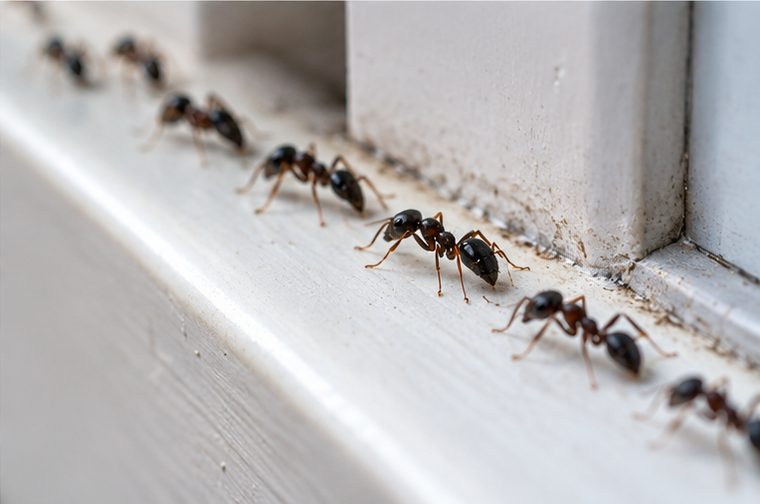
A town like Brentwood, with large gardens, woodland and farmland close by, offers ants far more nesting places than a built-up centre does. Colonies settle under paving, in lawn edges, beneath decking and in the soil around tree roots, then spread out across neighbouring gardens. A nest you cannot see can easily be two properties away from the house where the trail appears, which is why guessing rarely works.
Fallen leaves, compost heaps, log piles and plant pots all give shelter, and aphids on garden plants provide sugary honeydew that ants actively farm. That is why we often see more activity near a well-planted border. Cutting back plants that touch the house wall helps, because it removes the bridge ants use to reach windows and eaves. Keep compost bins and log stacks a little way from the back door as well.

We follow the trail from the kitchen outwards, noting every point at which ants enter, and then look for the nest in the most likely places nearby. Once we are confident about the species and the location, we treat the nest directly and place targeted treatment along the trail. It works through the workers carrying it home, so the colony itself is affected.
In Brentwood we are often asked about ants in period houses with older brick, timber frames and loft spaces, where there is more room for a colony to settle inside. If a nest is in the structure, treatment is adapted to the space, and we explain what is involved before we start so there are no surprises for you or your household.
Cafes, restaurants and shops along the busy Brentwood high street face the same problem on a smaller scale, with sugary spills and storage rooms inviting trails from pavements and neighbouring units. For everyone, the routine is the same: wipe surfaces, seal sweet food, keep bins closed and tell us promptly if the trail returns. We also cover Billericay, Epping and Basildon.
We cover towns and villages across Essex. Choose your area to see how ant control works locally.
A line of ants across the worktop usually means a scout found food and told the nest, and a few simple habits can break that chain.
Read the guide →
Flying ants are the winged males and young queens of an ant colony, and their sudden summer swarms are usually short lived and harmless.
Read the guide →
Most household pests leave clues behind, and learning to read droppings, damage, noises and timing will help you decide what you are dealing with and what to do next.
Read the guide →Dry ground makes it harder for ants to find food and moisture outdoors, so workers range further and are more likely to find a way into a kitchen or bathroom. Hot weather also speeds up colony growth. It is a good moment to check for trails and treat early.
Ants on a fruit tree are usually there for aphid honeydew rather than the fruit. They are not harming the tree directly, but they protect the aphids, which do. If the same ants are also entering your home, the nest is worth finding and treating.
Yes, when it is done properly. Treatments are placed in targeted spots, not sprayed across floors, and we tell you which areas to keep children and pets away from and for how long. Tell us about any pets before we start so we can plan around them.
Tell us what you have found and roughly where it is. We will come back to you — or call 01245 327 274 if it is urgent.
