
Fresh mounds of loose soil are the classic sign of a mole, but a few other things can look similar, so it pays to check properly.
Most people notice moles only after a patch of lawn has been turned into a scatter of soil heaps overnight. That is usually a fair guess, but earthworm casts, ant hills and the spoil from other burrowing animals can all leave small piles on grass. Before you decide anything, it helps to look closely at the shape of the soil and the pattern it makes across the garden. A calm, careful look now saves time and avoids treating the wrong problem later on.
A molehill is a rounded cone of fine, crumbly soil, often with no visible hole at the top because the animal plugs the shaft behind it. The soil is usually clean, with few stones or roots, because it has been pushed up from deeper down. Mounds tend to be dotted along the line of a hidden tunnel, so the pattern across the lawn tells you a lot.
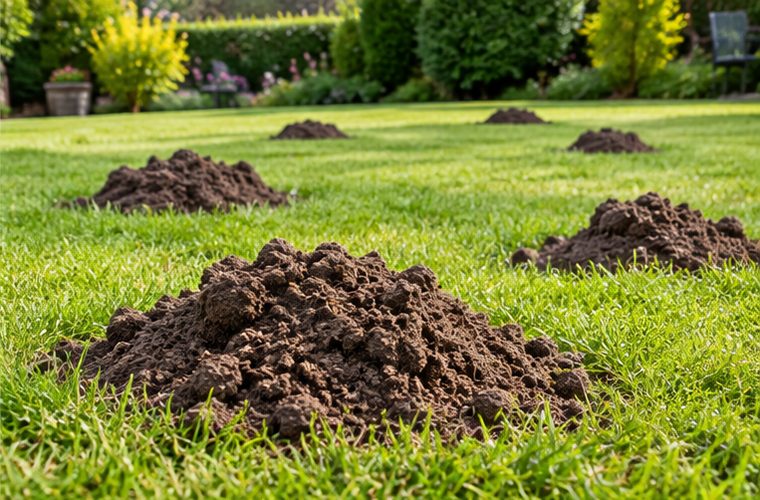
Earthworm casts are small, tight coils of soil and are far smaller than a molehill. Ant nests leave fine, sandy heaps with a visible entrance. Rabbits and voles tend to leave open holes rather than soil cones, and rats usually dig a clear round burrow entrance beside walls or under sheds. If you see open holes with no mound, you are probably not dealing with a mole at all. Looking at the shape, the soil texture and whether there is an open hole usually settles the question within a minute or two.
Moles favour soft, damp ground with plenty of worms. In Essex that includes lawns backing onto farmland and field margins, gardens near the Epping Forest edge, and plots on the lower, damper land around the estuary and rivers. They also appear in new-build estates where turf was laid over disturbed ground, and in older gardens with mature lawns.
Activity is often most obvious in autumn and spring, when the soil is moist and easy to work. In a long dry spell the animal may dig deeper and mounds can become less frequent, which can make people think the problem has gone when it has only gone out of sight. Fresh soil after a wet night is a particularly reliable clue.
Start by watching rather than acting. Make a note of where fresh mounds appear over a week or two, and take a few photos so the pattern is clear. Look for tunnels by gently pressing along a raised ridge, which will often collapse and show whether it is reopened the next day. Flatten fresh mounds with a rake so you can tell which are new, and keep children and pets away from soft, undermined ground until you know how far the tunnels run.
Please avoid home remedies sold as quick fixes, and do not pour anything into tunnels or put anything harmful into the soil. These tend to be unreliable and can harm pets, wildlife and your lawn. Digging up the turf to hunt for the animal rarely works and often makes the damage worse. If you are unsure what you are dealing with, it is better to ask than to guess.
If the mounds keep appearing, if tunnels are spreading towards a patio, vegetable bed or sports lawn, or if you cannot tell whether it is a mole, we can identify the cause and deal with it properly. A visit lets us confirm the species, trace the tunnel runs and use the right method for your garden. We cover homes and commercial grounds across Essex.
If you would rather not deal with it yourself, call us on 01245 327 274 or send an enquiry below. You can also read more about our garden mole removal service.
 BPCA Member
 CHAS Accredited
 Buy With Confidence
 Three Best Rated 2026
We cover towns and villages across Essex. Choose your area to see how garden mole removal works locally.

If new molehills keep appearing after you have cleared the old ones, the cause is usually food, soft soil and a tunnel network that never really goes away.
Read the guide →
Most household pests leave clues behind, and learning to read droppings, damage, noises and timing will help you decide what you are dealing with and what to do next.
Read the guide →
Rats are secretive and mostly active after dark, so the first clues are usually small marks and sounds rather than a sighting of the animal itself.
Read the guide →A molehill is a larger, rounded cone of crumbly soil with no obvious entrance, usually in a line or scattered across the lawn. An ant hill is smaller and sandier, often with a visible entrance, and you will see ants moving in and out of it during warm weather.
Moles live underground and work at all hours, so you do not usually see them at all. What you notice is the soil they push up. Mounds often seem to appear overnight simply because the animal has been digging while you were indoors, not because it only works in the dark.
A single mole can cause a surprising amount of disturbance, because it digs long networks of tunnels while hunting worms. Lawns usually have just one or two animals at a time, but even that can leave a lot of mounds and soft, uneven turf, especially after wet weather.
Yes, raking fresh soil flat is safe and helps you see which mounds are new. You can also use the loose soil as topsoil elsewhere in the garden. Flattening them will not remove the animal, so if fresh mounds keep appearing, it is worth asking us to take a look.
Tell us what you have found and roughly where it is. We will come back to you — or call 01245 327 274 if it is urgent.
