
For many people in Clacton-on-Sea the garden is the centre of daily life, whether it is the lawn behind a bungalow, the grass outside a retirement home or a small holiday property. Molehills spoil that quickly. A neat green space becomes bumpy and soft, and it can be tiring to keep clearing up the soil.
We find out whether a mole is truly the cause, locate the tunnels it uses most and trap there, checking at sensible intervals. Moles never come inside, so our visits concern the ground only. We keep disruption low and explain every step in plain terms.
 BPCA Member
 CHAS Accredited
 Buy With Confidence
 Three Best Rated 2026

Clacton-on-Sea has a great many bungalows with level, easy-to-manage lawns, and these suit moles well because the soil is usually soft and well fed with worms. Retirement homes and sheltered housing often have wider communal lawns too, where a hill in the middle of the grass can be a trip hazard as well as an eyesore for residents, staff and their visitors.
Fresh soil heaps are the clearest sign, along with lines of lifted grass crossing the lawn. In CO15 and CO16 the activity often shows in spring and autumn, when the ground is damp, although moles keep working all year round. If hills are springing up where residents or visitors walk, it is worth having the garden looked at without delay. A quick look often settles whether it is a mole.

We look for the main run, the tunnel that the mole travels through repeatedly, and set traps inside it. Short feeding branches are ignored because they are only used once. After placing the traps we return on a regular schedule, so none is left in the ground longer than needed, and we take away anything we catch and leave the lawn as tidy as we can.
In communal areas we are careful about where traps go and how the turf is left, so that people using the garden are not put at risk. We talk to you or the site manager before we start and agree who needs to know. The aim is a quiet, orderly job in Clacton-on-Sea, with straightforward advice on how things should look afterwards.
Once the moles have gone, rake the soil flat and use it to fill any dips, since a level lawn is safer to walk across. Firm down the collapsed tunnels and reseed bare patches in mild, damp weather. In Clacton-on-Sea this can often be a simple weekend job. We also cover Colchester, Witham and Maldon, and can talk you through repairs.
We cover towns and villages across Essex. Choose your area to see how garden mole removal works locally.
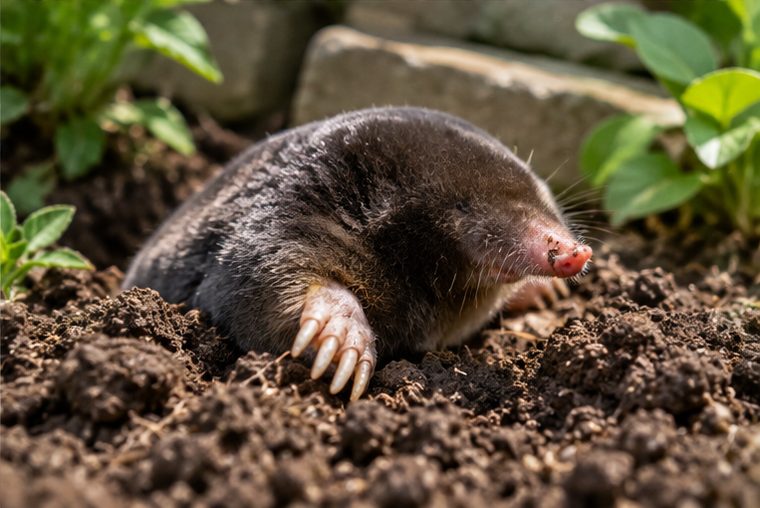
Fresh mounds of loose soil are the classic sign of a mole, but a few other things can look similar, so it pays to check properly.
Read the guide →If new molehills keep appearing after you have cleared the old ones, the cause is usually food, soft soil and a tunnel network that never really goes away.
Read the guide →
Most household pests leave clues behind, and learning to read droppings, damage, noises and timing will help you decide what you are dealing with and what to do next.
Read the guide →They can be, particularly when hills sit on paths or open lawn where residents walk. Levelling them after the moles are removed makes the ground safer. Until then, it is sensible to mark or cordon the worst spots.
Moles stay active all year, so tunnels can spread while the property is empty. Acting early is simpler than returning to a ruined lawn at the start of the season. We can check and trap while you are away if access is arranged.
Traps are set below ground in the tunnels and covered over, so they are not exposed on the lawn. We still tell you exactly where they are and talk through precautions for any dogs or children using the garden.
Tell us what you have found and roughly where it is. We will come back to you — or call 01245 327 274 if it is urgent.
